Best Winter Fabrics for School Uniforms in India: A Complete Guide
Choosing the right fabric is one of the most important decisions when designing winter school uniforms in India. A good winter uniform should provide warmth and comfort while also being durable, easy to maintain, and suitable for everyday school activities.
India has different winter conditions across regions. Schools in North India may require heavier and warmer fabrics, while schools in areas with mild winters may prefer lightweight fabrics that allow easy movement.
In this guide, we will explore the best winter fabrics for school uniforms in India, their benefits, ideal applications, and important factors schools should consider before placing bulk uniform orders.
Best Winter Fabrics for School Uniforms in India
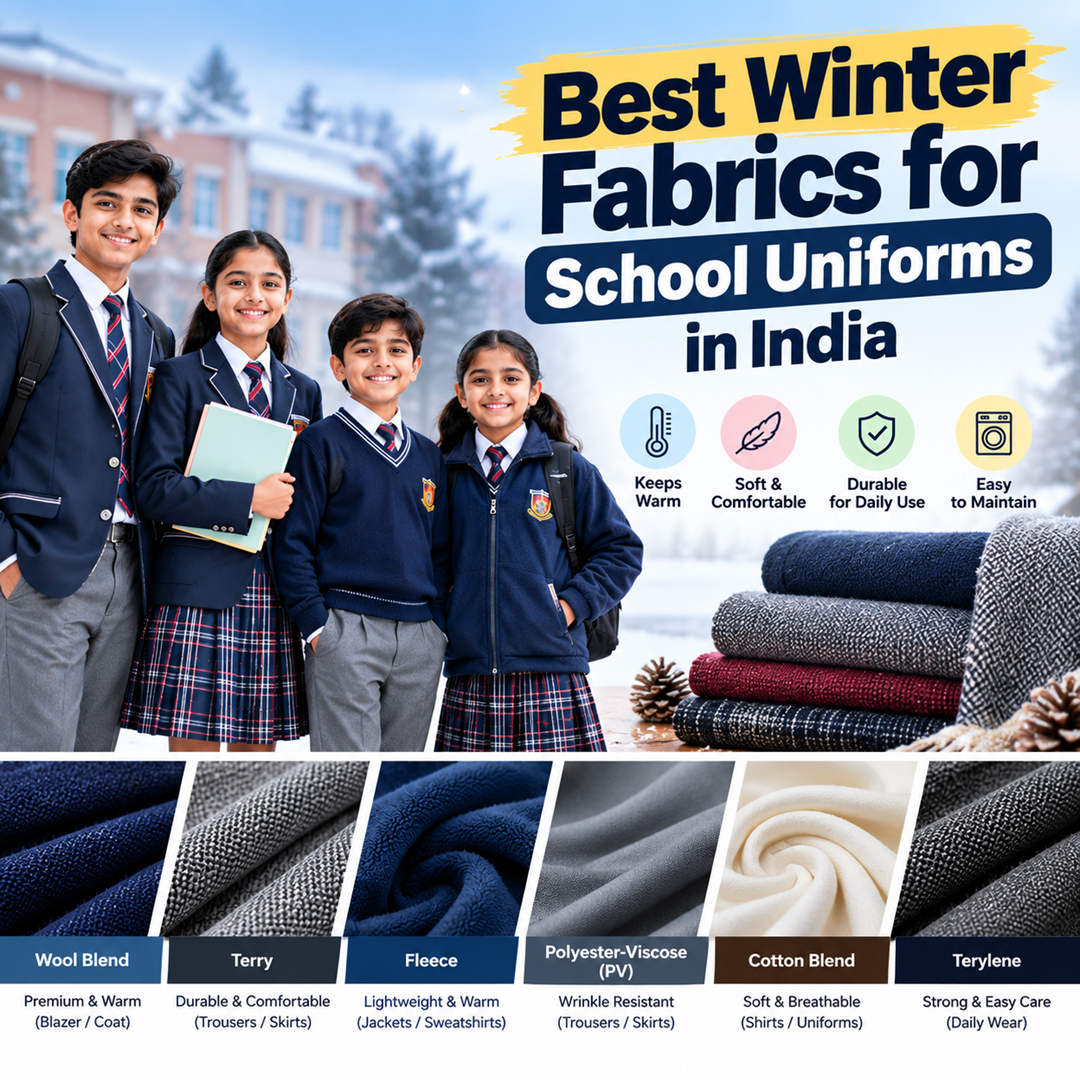
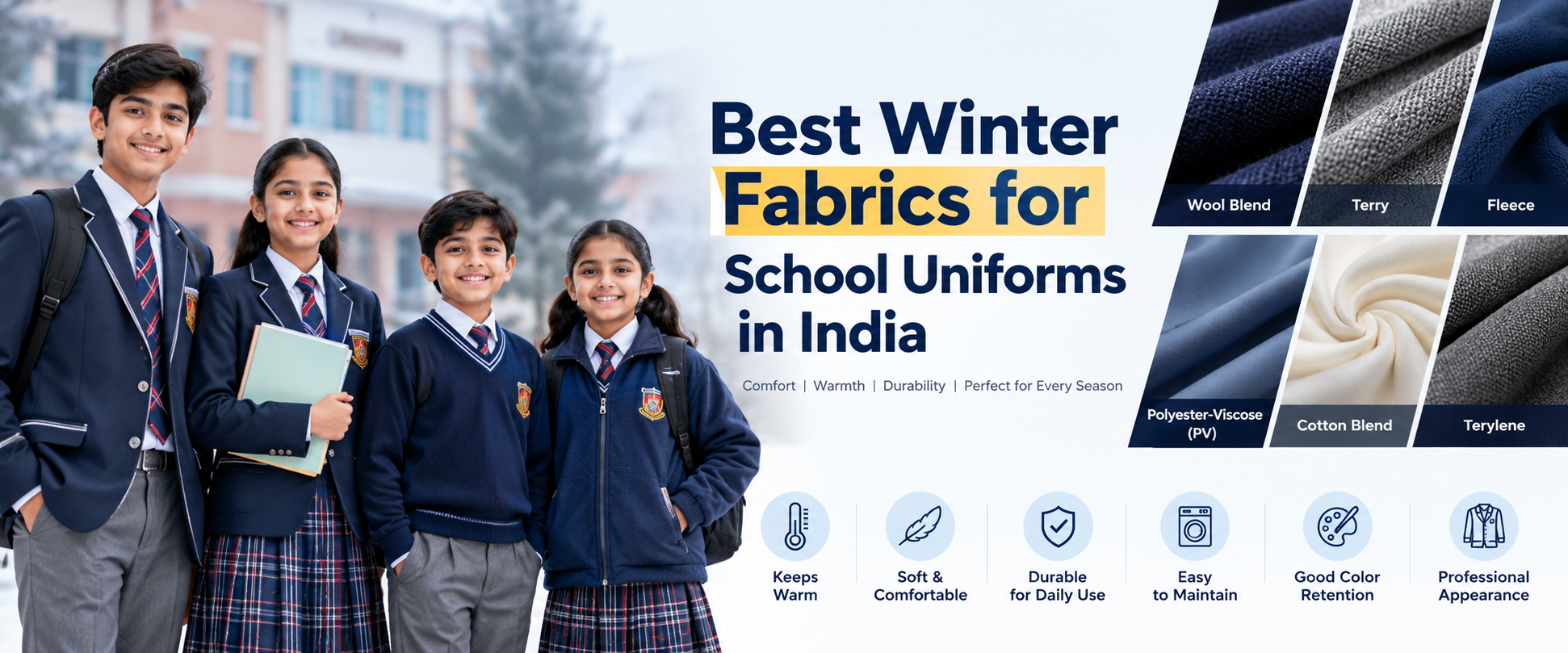
Some of the most commonly used fabrics for winter school uniforms include Wool Blends, Terry, Fleece, Polyester-Viscose (PV), Cotton Blends, and Terylene.
Let’s understand each fabric in detail.
1. Wool Blend Fabric
Wool blend is one of the most popular choices for school blazers, winter coats, and formal winter uniforms.
Blending wool with synthetic fibers such as polyester can improve durability, shape retention, and ease of maintenance while maintaining the warmth and premium appearance associated with wool.
Benefits of Wool Blend Fabric
- Excellent warmth
- Premium and professional appearance
- Comfortable in cold weather
- Good durability
- Suitable for formal school uniforms
- Helps maintain a structured look
Best Uses
- School Blazers
- Winter Coats
- Formal Winter Uniforms
- School Jackets
For schools located in colder parts of India, wool-blend fabrics can be a practical option for outerwear.
2. Terry Fabric
Terry fabric is another popular option for winter school uniforms. It offers a useful combination of warmth, durability, and everyday comfort.
It can be suitable for students who wear their uniforms regularly and need fabric that can withstand frequent use.
Benefits of Terry Fabric
- Warm and comfortable
- Durable for everyday school use
- Easy to maintain
- Good appearance
- Suitable for regular winter wear
- Available in different weights and compositions
Best Uses
- Winter Trousers
- Winter Skirts
- School Uniform Bottoms
- Winter Formal Wear
Terry fabric can be particularly useful for schools looking for a balance between comfort and durability.
3. Fleece Fabric
Fleece is a lightweight and warm fabric that is widely used for school sweatshirts, jackets, pullovers, and sportswear.
One of the biggest advantages of fleece is that it can provide warmth without making the garment excessively heavy.
Benefits of Fleece
- Lightweight
- Warm
- Soft and comfortable
- Easy to wear
- Suitable for active students
- Good for layering
- Ideal for casual winter schoolwear
Best Uses
- School Sweatshirts
- Winter Jackets
- Sports Jackets
- Winter Pullovers
- House Sportswear
Fleece is particularly suitable when schools want a comfortable winter layer that allows students to move easily.
4. Polyester-Viscose (PV) Fabric
Polyester-Viscose, commonly known as PV fabric, is a practical choice for school uniforms.
It combines the durability and easy-care properties of polyester with the appearance and feel provided by viscose.
Benefits of PV Fabric
- Durable
- Wrinkle resistant
- Easy to maintain
- Professional appearance
- Good shape retention
- Suitable for regular school use
- Available in a wide range of colors
Best Uses
- School Trousers
- School Skirts
- Formal Uniforms
- Winter Uniform Bottoms
PV fabric can be a practical choice for schools that need uniforms capable of handling frequent use and regular washing.
5. Cotton Blend Fabric
Cotton blend fabrics combine cotton with other fibers to provide a balance of comfort, durability, and easy maintenance.
Cotton is known for its soft feel and breathability, making cotton-blend fabrics suitable for students who wear uniforms for several hours every day.
Benefits of Cotton Blend Fabric
- Comfortable
- Soft feel
- Breathable
- Suitable for long school hours
- Easy to wear
- Can provide good everyday comfort
Best Uses
- School Shirts
- T-Shirts
- Light Winter Uniforms
- Layering Garments
Cotton blends can be especially useful in regions where winters are moderate rather than extremely cold.
6. Terylene Fabric
Terylene is a polyester-based fabric that is known for its strength and easy-care characteristics.
It can be considered for school uniforms where durability and low-maintenance requirements are important.
Benefits of Terylene
- Strong and durable
- Easy to wash
- Quick drying
- Wrinkle resistant
- Suitable for regular use
- Easy to maintain
Best Uses
- School Trousers
- Skirts
- Uniform Blends
- Daily-Wear School Garments
How to Choose the Right Winter Fabric for School Uniforms?
Selecting a winter uniform fabric should not be based only on warmth. Schools should consider several factors before finalizing the fabric.
1. Consider the Local Climate
Winter conditions vary significantly across India.
Schools in colder regions may require heavier fabrics, while schools in areas with moderate winters may prefer lightweight fabrics or layering systems.
For example:
- Cold regions: Wool blends and heavier fabrics
- Moderate winters: Terry and PV blends
- Light winter conditions: Cotton blends and layering fabrics
- Sportswear: Fleece and lightweight synthetic blends
2. Prioritize Student Comfort
Students may wear school uniforms for six to eight hours or more each day.
The fabric should allow comfortable movement and should not feel excessively heavy or restrictive.
Comfort is particularly important for younger students and students who participate in outdoor activities.
3. Check Fabric Durability
School uniforms experience regular use, washing, ironing, and outdoor activity.
A durable fabric can help uniforms maintain their appearance for longer and reduce the need for frequent replacement.
Before placing a bulk order, schools should evaluate:
- Fabric strength
- Stitching compatibility
- Pilling resistance
- Shrinkage
- Color fastness
- Shape retention
4. Choose Easy-Care Fabrics
Parents generally prefer uniforms that are easy to wash, dry, and iron.
Fabrics with good wrinkle resistance and easy-care properties can make daily uniform maintenance more convenient.
5. Consider Color Fastness
School uniforms usually follow specific school colors.
Good color fastness is important because uniforms may be washed frequently during the academic year.
Schools should ask manufacturers or suppliers for fabric specifications and samples before approving a large production order.
6. Keep the Budget in Mind
The most expensive fabric is not necessarily the most suitable fabric for every school.
Schools should evaluate the overall value of the fabric by considering:
Quality + Comfort + Durability + Maintenance + Cost
This approach can help schools select fabrics that meet their requirements while staying within their uniform budget.
Best Fabrics for Different Winter School Uniform Items
Different uniform garments may require different types of fabrics.
| Winter Uniform Item | Recommended Fabric Options |
|---|---|
| School Blazer | Wool Blend, Polyester-Wool Blend |
| Winter Trousers | Terry, PV, Wool Blend |
| Winter Skirt | Terry, PV, Wool Blend |
| School Sweatshirt | Fleece |
| Winter Jacket | Fleece, Polyester Blend |
| School Pullover | Acrylic, Wool Blend |
| School Shirt | Cotton Blend, Polyester-Cotton |
| Winter Coat | Wool Blend, Polyester Blend |
| Sports Jacket | Fleece, Polyester Blend |
The final fabric selection should depend on the school’s climate, uniform design, student requirements, and budget.
Why Fabric Quality Matters in School Uniforms
Fabric quality directly affects the overall performance and appearance of a school uniform.
Low-quality fabric may result in problems such as:
- Color fading
- Excessive shrinkage
- Pilling
- Poor shape retention
- Excessive wrinkles
- Reduced durability
- Uncomfortable wearing experience
High-quality fabric, combined with proper stitching and finishing, can help schools maintain a consistent and professional uniform appearance.
Winter School Uniform Fabric for Bulk Orders
Schools ordering winter uniforms in bulk should work closely with an experienced school uniform manufacturer.
Before approving the final production, schools should discuss:
- Fabric composition
- Fabric weight or GSM
- Color specifications
- Color fastness
- Shrinkage
- Size chart
- Stitching specifications
- Embroidery requirements
- Logo placement
- Sample approval
- Production timeline
- Minimum order quantity
- Packaging requirements
A pre-production sample can help schools confirm the fabric, color, measurements, design, and finishing before bulk manufacturing begins.
Best Winter Fabric for School Uniforms: Which One Should You Choose?
There is no single fabric that is suitable for every school in India.
The best choice depends on the school’s location, weather conditions, uniform design, student age group, usage, and budget.
For Cold Weather
Wool Blends and heavier blended fabrics can be suitable for blazers, coats, and formal winter uniforms.
For Moderate Winters
Terry and PV fabrics can be practical choices for trousers, skirts, and daily winter uniforms.
For Sweatshirts and Jackets
Fleece is a popular option because it is lightweight, warm, and comfortable.
For Daily Formal Uniforms
PV and other polyester blends can provide durability and easy maintenance.
For Comfort-Focused Garments
Cotton blends can provide a comfortable option, particularly where winters are relatively mild.
How Schools Can Get Better Value from Winter Uniforms
A well-planned winter uniform program can help schools balance quality and cost.
Instead of selecting the same fabric for every garment, schools can choose fabrics according to the purpose of each uniform item.
For example:
Blazer → Wool Blend
Trousers → PV or Terry
Sweatshirt → Fleece
Shirt → Cotton Blend
Sports Jacket → Polyester/Fleece Blend
This approach can create a practical winter uniform system that combines warmth, comfort, durability, and professional appearance.
Choosing a Reliable School Uniform Manufacturer
The quality of the final school uniform depends not only on the fabric but also on the manufacturing process.
An experienced school uniform manufacturer in India can help schools with fabric selection, uniform design, sizing, sampling, customization, embroidery, bulk production, and quality control.
When choosing a manufacturer, schools should look for:
- Experience in school uniforms
- Fabric sourcing capabilities
- Custom uniform manufacturing
- Bulk production capacity
- Quality control
- Consistent sizing
- Professional finishing
- On-time delivery
- Sample development
- Customized school branding
For schools ordering uniforms in large quantities, working directly with a manufacturer can also simplify the production and quality-control process.
Frequently Asked Questions
What is the best winter fabric for school uniforms in India?
Popular options include wool blends, Terry, Fleece, Polyester-Viscose (PV), cotton blends, and other polyester blends. The right choice depends on the local climate and the specific uniform garment.
Which fabric is best for school blazers?
Wool blends and wool-polyester blends are commonly considered for school blazers because they can provide warmth, structure, and a formal appearance.
Is fleece suitable for school winter uniforms?
Yes. Fleece is lightweight, warm, and comfortable, making it suitable for school sweatshirts, jackets, sportswear, and other winter layers.
What is PV fabric used for in school uniforms?
PV stands for Polyester-Viscose. It is commonly used for trousers, skirts, and formal school uniforms because of its durability, professional appearance, and easy-care properties.
Which fabric is best for winter school trousers?
Terry, PV, wool blends, and other suitable blended fabrics can be considered for winter school trousers depending on the climate, design, and budget.
How can schools choose the right winter uniform fabric?
Schools should consider local weather conditions, student comfort, fabric durability, color fastness, maintenance requirements, uniform design, and budget before selecting a fabric.
Should schools test fabric samples before bulk ordering?
Yes. Reviewing and approving fabric and garment samples before bulk production can help schools verify color, texture, weight, sizing, stitching, and overall quality.
Conclusion
Choosing the Best Winter Fabrics for School Uniforms in India requires careful consideration of climate, comfort, durability, maintenance, appearance, and cost.
Wool blends can be suitable for blazers and formal winter garments, while Terry and PV fabrics can work well for daily winter uniforms. Fleece is a practical option for sweatshirts and jackets, while cotton blends can provide comfort in areas with moderate winters.
The right combination of fabrics can help schools create winter uniforms that are comfortable for students, durable for everyday use, easy for parents to maintain, and professional in appearance.
If your school is planning a new winter uniform or placing a bulk order, selecting the right fabric and working with an experienced school uniform manufacturer can make a significant difference in the final quality of the uniforms.